Introduction
For any laboratory involved in culturing microorganisms — whether for research, diagnostics, or quality control — the bacteriological incubator is a foundational piece of equipment. But what exactly is it, and how does it differ from other incubators like the BOD incubator?
In this guide, we'll cover everything you need to know about bacteriological incubators — from their working principle to their key applications.
What is a Bacteriological Incubator?
A bacteriological incubator is a temperature-controlled chamber designed to provide optimal, stable conditions for the growth and cultivation of bacteria, fungi, and other microorganisms. It maintains a consistent temperature — typically in the range of 5°C above ambient up to around 60°C — to support microbial culture work without the added humidity or cooling features found in more specialized incubators.
Bacteriological incubators are essential in:
- Microbiology laboratories
- Clinical and diagnostic labs
- Food and beverage testing labs
- Academic and research institutions
- Pharmaceutical quality control
How Does a Bacteriological Incubator Work?
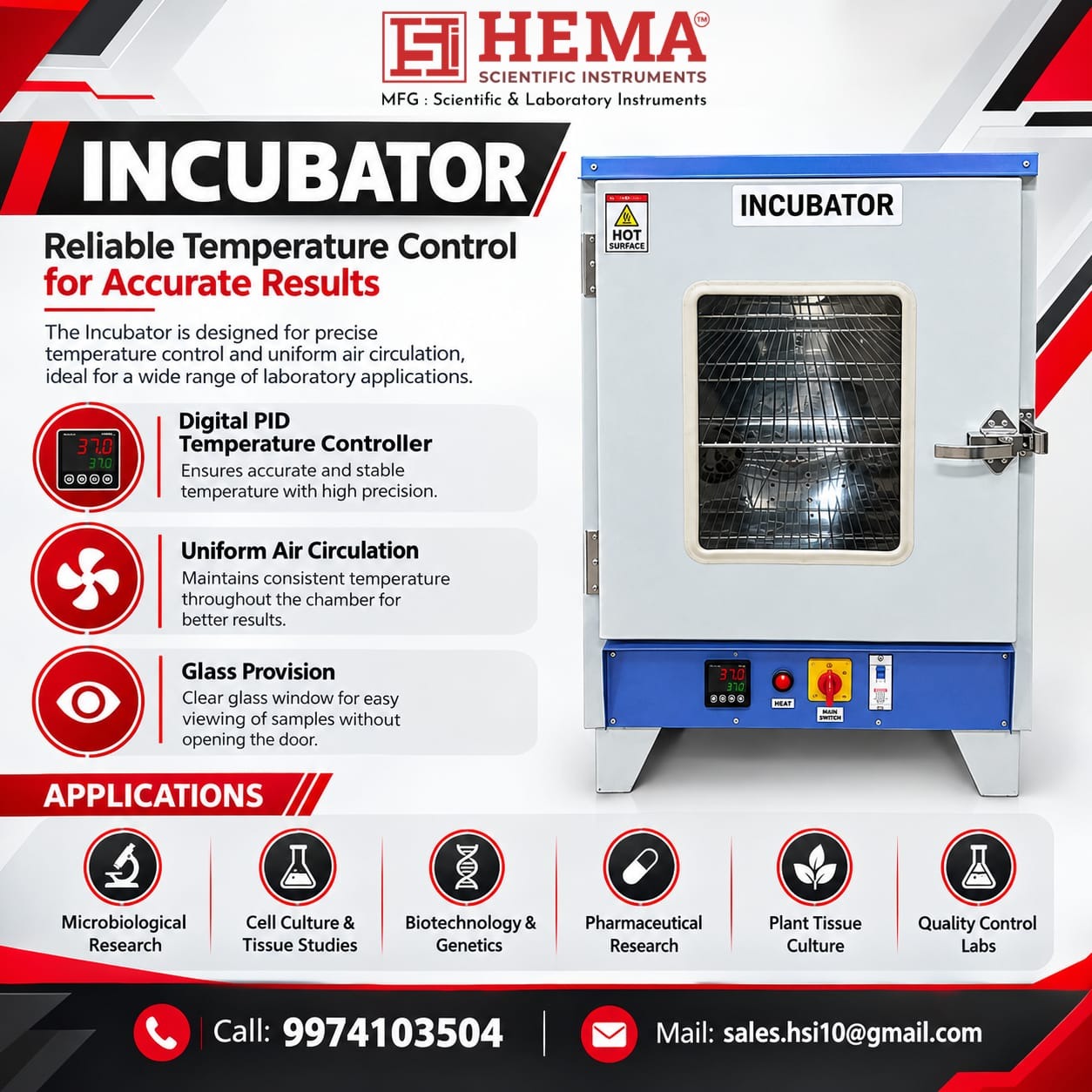
A bacteriological incubator relies on natural or forced air convection to maintain a stable internal temperature suited for microbial growth. Key components include:
- Heating element — maintains consistent internal temperature
- Digital/analog thermostat controller — allows precise temperature setting and monitoring
- Insulated chamber — minimizes temperature fluctuation from external conditions
- Air circulation system — ensures uniform temperature throughout the chamber
- Shelving/racks — hold petri dishes, culture tubes, and flasks
Culture samples are placed inside the chamber, and the incubator maintains the required temperature for the incubation period — allowing microorganisms to grow under controlled, reproducible conditions.
Key Applications of a Bacteriological Incubator
- Microbial culture growth — bacteria, fungi, and yeast cultivation
- Clinical diagnostics — pathogen identification and testing
- Food and beverage quality testing — microbial contamination checks
- Academic and research training — teaching labs and experimental research
- Pharmaceutical quality control — sterility and microbial limit testing
Bacteriological Incubator vs BOD Incubator: What's the Difference?
A common question for lab buyers is how a bacteriological incubator compares to a BOD incubator:
- Bacteriological incubator — general-purpose microbial culture growth, typically without refrigeration/cooling function
- BOD incubator — includes cooling capability to maintain precise low temperatures (commonly 20°C), specifically for biochemical oxygen demand testing in water samples
Why Temperature Stability Matters
Inconsistent or fluctuating temperatures can significantly affect microbial growth rates and skew culture results. That's why labs should choose bacteriological incubators with reliable thermostatic control, good insulation, and uniform internal air circulation.
Choosing the Right Bacteriological Incubator for Your Lab
When selecting a bacteriological incubator, consider:
- Chamber capacity based on sample/culture volume
- Temperature range and accuracy (± tolerance)
- Digital vs analog controller
- Shelving configuration and material
- Build quality and insulation for energy efficiency
- Compliance with relevant laboratory standards
Frequently Asked Questions
Q1. What temperature range does a bacteriological incubator cover? Most bacteriological incubators operate from around 5°C above ambient temperature up to 60°C, depending on the model and application.
Q2. What is the difference between a bacteriological incubator and a BOD incubator? A bacteriological incubator is used for general microbial culture growth, while a BOD incubator includes cooling capability for precise low-temperature biochemical oxygen demand testing.
Q3. Who uses bacteriological incubators? Microbiology labs, clinical and diagnostic labs, food testing facilities, academic institutions, and pharmaceutical quality control labs.
Q4. How long are samples typically incubated? Incubation periods vary by application, ranging from 24–48 hours for standard bacterial cultures to several days for slower-growing organisms.
Q5. How often should a bacteriological incubator be calibrated? It's recommended to calibrate bacteriological incubators periodically (commonly every 6–12 months) to maintain temperature accuracy and reliable culture results.
Request a Quote
Hema Scientific Instruments
For pricing, technical details, specifications or bulk requirements:
Email: sales.hsi10@gmail.com
Website: www.hema-scientific.com
Phone: +91-9974103504